
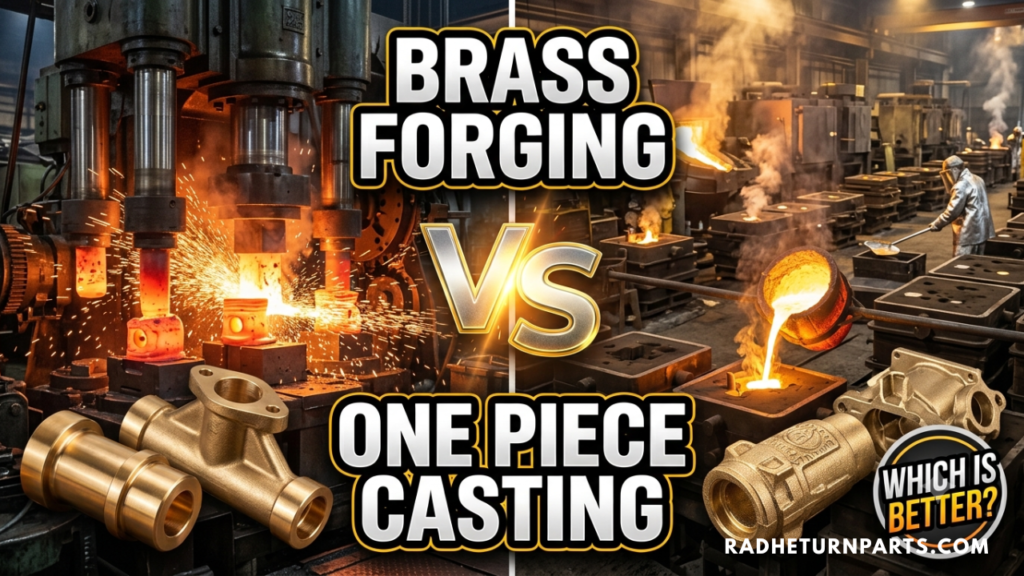
Choosing the right manufacturing process directly affects product quality and performance. Brass forging and one piece casting are two widely used methods. However, each process delivers different mechanical properties and production advantages.
This guide compares brass forging vs one piece casting. It helps manufacturers, buyers, and engineers make an informed decision.
Brass forging is a manufacturing process that shapes heated brass using compressive force. High pressure forms the component into its final shape without melting the metal.
As a result, the brass grain structure becomes compact and aligned. Therefore, forged brass parts offer superior mechanical strength and excellent durability.
Common forged brass products include:
One piece casting produces brass components by pouring molten brass into a mold. The metal cools and solidifies into the required shape.
This process creates complex geometries with minimal machining. Moreover, manufacturers can produce intricate parts economically.
Typical cast brass products include:
Brass forging produces stronger components because the grain flow follows the part’s shape. Consequently, forged parts resist cracking under heavy loads.
On the other hand, cast brass contains a random grain structure. Therefore, it generally offers lower tensile and impact strength.
Forged brass performs better in demanding environments. It handles repeated stress, vibration, and pressure without failure.
Meanwhile, cast brass works well in moderate-duty applications. However, it may develop internal defects during solidification.
Casting easily creates complicated shapes with fewer production steps. As a result, designers enjoy greater flexibility.
Forging also provides excellent accuracy. However, highly complex designs often require secondary machining.
Cast components usually achieve smoother surfaces directly from the mold. Therefore, they often require less finishing.
Forged parts may need machining or polishing after production. Nevertheless, they provide excellent functional performance.
Tooling for forging costs more initially. However, high-volume production reduces the cost per component.
Casting usually offers lower tooling costs for smaller production runs. Consequently, it becomes economical for limited quantities.
Forging significantly reduces internal voids and porosity. Therefore, forged components deliver greater reliability.
Casting can develop shrinkage cavities or air pockets during cooling. Although quality control minimizes these issues, they remain possible.
Brass forging provides several important benefits.
Consequently, forged brass is the preferred choice for critical industrial applications.
One piece casting also offers valuable benefits.
Therefore, casting remains ideal for decorative and complex products.
Forged brass is widely used in industries requiring strength and reliability.
Common applications include:
Cast brass serves industries where complex geometry matters more than maximum strength.
Popular applications include:
The right process depends on your application.
Choose brass forging if your component must withstand high pressure, repeated loading, or harsh operating conditions. Although the initial tooling cost is higher, forged parts deliver outstanding long-term performance.
Choose one piece casting if your design includes complex shapes, decorative features, or lower mechanical requirements. Furthermore, casting offers a cost-effective solution for smaller production quantities.
Both manufacturing methods have unique advantages. Brass forging produces stronger, denser, and more reliable components. Consequently, it remains the preferred option for critical engineering applications.
In contrast, one piece casting offers outstanding design flexibility and lower tooling costs. Therefore, it works well for complex or decorative brass products.
Before selecting either process, evaluate your strength requirements, production volume, budget, and design complexity. Making the right choice improves product performance while reducing manufacturing costs over time.
Radhe Industries is a trusted manufacturer of precision brass components and CNC turned parts based in Jamnagar, Gujarat, India’s renowned brass manufacturing hub.
+91 7874824696
Contact@radheturnparts.com Parth@radheturnparts.com
GIDC Phase 2, Plot no- 85, Dared, Jamnagar.
Copyright ©2026. All Rights Reserved by Radhe Industries
